
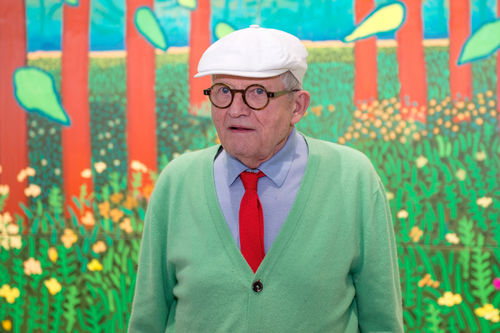
Hockney has spent more than sixty years insisting on a single proposition: that picture-making, in any medium and at any moment, is an act of looking, and that the discipline of looking with attention is what gives a painting its life.
Hockney came out of working-class Yorkshire and into the most generative postwar moment in British art. His training in Bradford gave him a strong foundation in observational drawing, and his entry into the Royal College of Art in 1959 placed him at the centre of the generation that would reshape British painting in the 1960s, alongside R. B. Kitaj, Peter Blake, Allen Jones, and others, at exactly the moment Pop Art was emerging on both sides of the Atlantic. His openness about his sexuality, almost unique among major British artists of the period, was already evident in the paintings he was making at the RCA.
The decisive move came with his first journey to Los Angeles. The city's light, architecture, swimming pools, and openly sensuous domestic life gave him a subject he had been searching for, and the acrylic paintings of pools, lawns, showers, and Californian interiors that followed across the next decade, Peter Getting Out of Nick's Pool, Mr and Mrs Clark and Percy, Portrait of an Artist (Pool with Two Figures), established the visual identity by which he is now most widely known. He divided his time between England and the United States until 1978, when he settled permanently in Los Angeles.
His practice has been defined throughout by an unusual restlessness with medium. The swimming-pool paintings were followed by photographic "joiners" composed of overlapping Polaroid prints, large-scale stage designs for opera houses including Glyndebourne and the Metropolitan, drawings made directly on a fax machine, suites of iPad drawings, and the long sequence of Yorkshire landscape paintings he produced after his return to East Yorkshire in the early 2000s. His 2001 book Secret Knowledge: Rediscovering the Lost Techniques of the Old Masters, an extended argument that Old Master painters from the early Renaissance forward had used optical devices to compose their work, placed him at the centre of an art-historical controversy that continues to be debated.
The institutional and critical recognition that has followed has been continuous and international, with major retrospectives at Tate Britain, the Metropolitan Museum of Art, the Centre Pompidou, the Royal Academy of Arts, and most recently the Fondation Louis Vuitton. The 2018 Christie's sale of Portrait of an Artist (Pool with Two Figures)confirmed his market position alongside his critical one, and his work has continued to attract record prices at auction.
His position in late-twentieth- and twenty-first-century art is now firmly settled. He is one of the few painters of his generation whose work is at once a permanent feature of the modernist canon and a living, evolving practice, still being made, still being exhibited, and still being argued about, well into his ninth decade.