
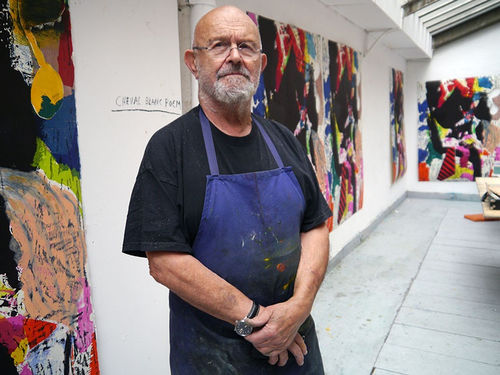
Dine's career rests on a quietly subversive proposition, that the ordinary object held over the years (a hammer, a bathrobe, a heart) is finally not a Pop emblem but a self-portrait, and his half-century of work has elaborated that proposition across more media than almost any other major American artist of his generation.
Dine came to art from a Cincinnati childhood that gave him many of his subsequent subjects. His grandfather and his father ran hardware stores, and the tools that became one of the recurring motifs of his career, hammers, axes, wrenches, paintbrushes, were the first objects he handled with any sustained attention. His subsequent academic training in Ohio and New England gave him a thorough technical foundation before his move to New York at twenty-three.
The decisive period of his early career was his immediate immersion in the early-1960s downtown New York avant-garde. The Happenings he staged in those years, including Car Crash and The Smiling Workman, placed him within the most experimental performance art of the period and gave him a working understanding of the body, the object, and the everyday in art. The early environments and assemblages he built around tools, clothes, and household objects translated those interests into the studio.
His emergence as a painter came rapidly. He was included alongside Andy Warhol, Ed Ruscha, Roy Lichtenstein, and others in the Pasadena exhibition that announced American Pop Art, and his early bathrobe paintings, vacant garments that read as both still life and self-portrait, quickly established his distinctive voice. But where Pop, in his own analysis, was concerned with the exterior surfaces of consumer culture, his own concerns were interior, personal, and emotionally weighted; the objects in his paintings were not symbols of contemporary life but instruments for the close examination of memory, feeling, and the artist's own body.
Across the decades since, his motifs have remained extraordinarily consistent, hearts, robes, tools, Pinocchio, the self-portrait, but the work has been pursued through an unusual range of media. He has produced one of the most substantial bodies of printmaking in American art, working with virtually every major American print workshop and producing thousands of prints, lithographs, etchings, and woodcuts. He has worked extensively in sculpture, photography, drawing, and stage design, has published several volumes of poetry, and has continued to extend the practice into his late eighties.
His position today is that of one of the most distinguished living American artists, an artist whose career runs against the standard narrative of Pop, and whose body of work, built around a small set of intimate, recurring images, has continued to grow in seriousness and depth across more than sixty years of working life.