
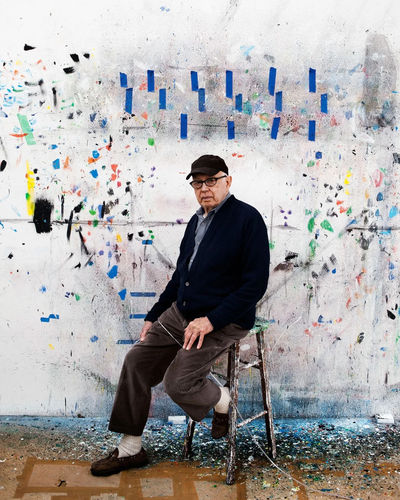
"To hell with pictures, they should be the wall.", Ellsworth Kelly
Ellsworth Kelly (May 31, 1923 – December 27, 2015) was an American painter, sculptor, and printmaker, widely regarded as one of the foundational figures of postwar American abstraction and the leading exponent of hard-edge painting. Born in Newburgh, New York, he studied briefly at the Pratt Institute in Brooklyn before being inducted into the U.S. Army in 1943, where he served with the 603rd Engineer Camouflage Battalion, the so-called Ghost Army of artist-soldiers tasked with deceiving Axis forces through inflatable tanks, sound effects, and painted illusion. His exposure to military camouflage during that service became part of his basic visual education in form, shadow, and the construction of the visible.
After the war he completed his training at the School of the Museum of Fine Arts in Boston (1946–48) and the École des Beaux-Arts in Paris (1948–49), and remained in France until 1954. The Paris years brought him into direct contact with Picasso, Matisse, Arp, and the Romanesque and Byzantine architectural traditions that would shape his approach to flat color and architectural scale. He returned to New York with a fully formed abstract idiom that effectively anticipated Minimalism by a decade. His honors include the Praemium Imperiale of the Japan Art Association (2000), the French Commandeur de l'Ordre des Arts et des Lettres (2001) and Officier de la Légion d'Honneur (2009), and the National Medal of Arts presented by President Obama in 2013. His work is held in essentially every major postwar collection, the Museum of Modern Art, the Whitney Museum of American Art, the National Gallery of Art, the Smithsonian American Art Museum, the Tate, the Centre Pompidou, the Art Institute of Chicago, and his only built work, the freestanding stone-and-stained-glass building Austin (2018), stands at the Blanton Museum of Art in Austin, Texas, as his final and most fully realized statement.