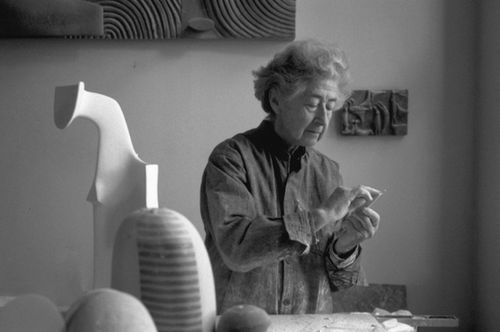
Duckworth's early life was conditioned by the political crises of mid-twentieth-century Europe. The Hamburg of her childhood was a major German port and a centre of the country's Jewish business and intellectual community, and the rise of Nazism in the early 1930s made her position there increasingly precarious. The emigration to England, at seventeen, ahead of her family, brought her to art school in Liverpool, where she struggled, by her own later account, to settle on a single discipline among the many traditions she wanted to master.
The years that followed her formal training were unsettled. The wartime work in the munitions factory, the period as a travelling puppeteer, and the years carving headstones gave her a hands-on familiarity with materials and labour but no clear artistic direction. The decisive turn came in the 1950s, when she discovered clay and recognized in it the medium that would carry her work for the rest of her life. Her subsequent formal ceramic training in London consolidated the technical foundations of her practice.
Her early ceramics worked in the broadly traditional studio-pottery idiom of mid-century England, but she moved rapidly toward a more abstract, sculptural approach that pushed against the boundaries of both functional ceramics and conventional sculpture. The hand-built forms she developed, pinched, slabbed, and coiled rather than thrown on the wheel, drew on natural and organic references and resisted the dominant Bernard Leach-derived studio-pottery tradition that had defined the British ceramic scene since the 1920s.
The move to Chicago to teach at the Midway Studios was the pivotal moment of her mature career. The university commission for the Geophysical Sciences mural gave her her first opportunity to work at architectural scale, and the resulting Earth, Water and Sky, incorporating topographical patterns derived from satellite photographs and large porcelain clouds suspended above the wall surface, placed her at the forefront of postwar American ceramic art. The subsequent Clouds Over Lake Michigan commission extended her work into a second monumental ceramic installation that has remained one of the most important pieces of public ceramic art in the city.
Her studio work over the next four decades consisted primarily of small to mid-size hand-built sculptures in porcelain, stoneware, and bronze, abstract organic forms whose smooth surfaces, careful interior spaces, and quiet presence have continued to define the upper register of contemporary studio ceramics. Her position today is settled at the highest level of late twentieth-century ceramic art, and her work is increasingly read alongside the contemporary American sculpture of her time rather than confined within the smaller frame of "ceramics" as a separate medium.