
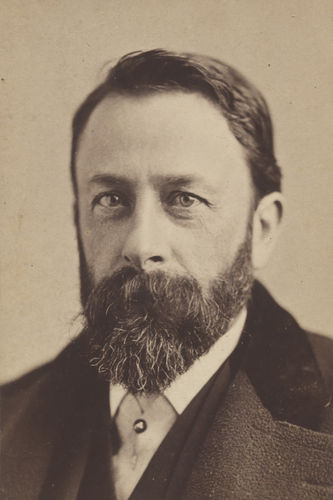
Bierstadt did more than any other painter of his generation to translate the scale of the American West into a visual idiom that European audiences could recognize as art on the highest order.
Bierstadt's path into painting was indirect. Brought to New Bedford as an infant, he grew up in a Massachusetts whaling town rather than in the German cultural milieu of his birth. His decision to return to Düsseldorf placed him in one of the most influential teaching environments of mid-nineteenth-century European painting, where he absorbed the academic emphasis on detailed drawing, structured composition, and atmospheric finish that would define his mature work.
Back in the United States, he aligned himself with the painters now described as the second generation of the Hudson River School, artists whose work extended the founders' attention to American wilderness with a heightened, sometimes theatrical handling of light and scale. Their style is often grouped with luminism, a tendency toward radiant, almost spiritualized atmospheric effects that Bierstadt pushed further than most of his contemporaries.
The decisive moment of his career came when he joined Lander on the western expedition. The sketches and studies he produced on that trip, and on subsequent travels through the West, became the source material for the panoramic exhibition pictures that made his reputation. Canvases such as The Rocky Mountains, Lander's Peak established a new ambition of scale in American landscape painting and helped fix the image of the West in the public imagination of the eastern United States and Europe alike.
His paintings entered major collections during his lifetime and remain in the holdings of the Metropolitan Museum of Art, the Smithsonian American Art Museum, the National Gallery of Art in Washington, the Wadsworth Atheneum, the National Gallery of Canada, and the United States Capitol, among other institutions in North America and Europe.
His critical standing shifted as the century turned. As Impressionism reshaped expectations for landscape painting, his grand academic style was increasingly dismissed as theatrical and old-fashioned, and he ended his career with his reputation in eclipse. The twentieth-century reassessment of nineteenth-century American art has since restored him to the front rank of his period, and his works are now read both as accomplished landscape paintings and as primary documents in the formation of American national imagery