
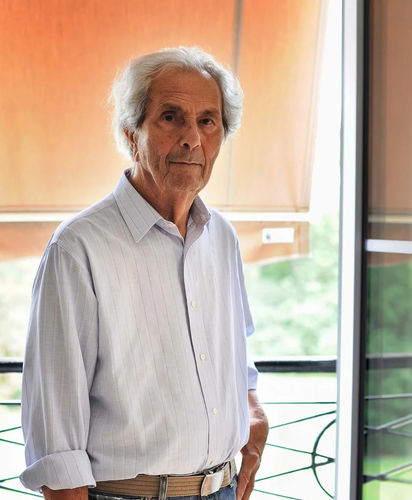
Crotto's career belongs to a small mid-twentieth-century American current, the painters who took the GI Bill to Europe, made their lives there, and built their work outside the New York gallery and museum system that dominated the careers of their stay-at-home contemporaries, and his fluency across French, Italian, and Mallorcan studio traditions distinguishes his sixty-year body of work from any single regional school.
Crotto came to art through wartime accident rather than early vocation. The University of Georgia freshman year had pointed him toward a different career; the Naval communications and coding work that followed his draft, and especially the years he spent in China, produced the first body of paintings he would seriously claim, and the decision to pursue art on his return to civilian life was made entirely on the basis of those wartime sketches and watercolours.
The Art Students League and the GI Bill gave him the foundation for his subsequent European education. The move to Paris, encouraged by the same currents that brought a substantial generation of postwar American painters to study at Léger's academy, placed him within one of the most active European art-teaching environments of the period. Léger's emphasis on Cubist construction, planar color, and the disciplined relationship between figure and ground became the technical underpinning of Crotto's mature style.
The two years in Florence at the Accademia extended his training into the European Old Master tradition. The combination of Léger's modernism and the Florentine academic study gave him an unusually broad foundation, and his subsequent work at the Atelier Lacourière, the Montmartre printmaking workshop that had produced editions for Matisse, Miró, Picasso, and most of the leading European modernists of the period, completed his technical apprenticeship.
The Deià years from the late 1950s onward shaped the second half of his life. The Mallorcan village, then a small fishing and farming settlement, had become one of the most distinctive postwar European art colonies under the gravitational pull of Graves and the international writers and painters who gathered around him, and Crotto's regular residence there gave him the slow rhythm of working life that produced his mature painting. He was an inveterate chess player and a fixture of the village's social life across the next half-century.
His painting and printmaking continued steadily through his final decades in both Paris and Mallorca, and his work has continued to circulate through European galleries in the years since his death.