
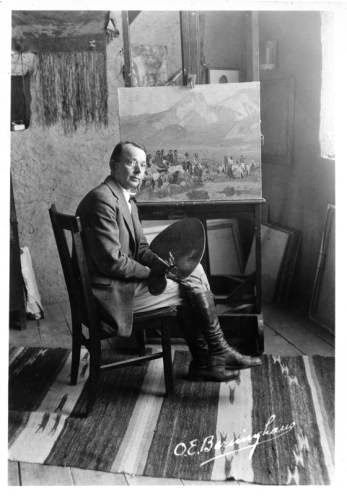
Berninghaus's career runs across the seam between two of the great working subjects of late-nineteenth- and early-twentieth-century American art, the Mississippi-Missouri commercial heartland that produced him and the Taos Pueblo and Southwestern frontier that made him, and his paintings register both with unusual care.
Berninghaus came to art through one of the most working-class American training paths of the late nineteenth century. His father's lithography business gave him an early familiarity with the materials and techniques of commercial art, and his teenage employment at a local lithography firm placed him within one of the most active print and engraving environments in the central United States. The night classes he attended at the city's school of fine arts gave him academic training in drawing and painting, and the combination of working-day commercial art and evening studio practice produced an unusually disciplined young artist by his early twenties.
The 1899 Denver and Rio Grande Railway commission was the decisive event of his career. The trip exposed him to the landscapes, peoples, and atmospheric conditions of the high desert Southwest for the first time, and the visit to Taos, at that point a small, remote, but artistically aware Spanish-and-Pueblo town, produced an immediate and lifelong attachment. Over the following decades he returned annually, building a studio practice in Taos alongside his St. Louis commercial career and gradually shifting the balance of his working life toward the easel painting that would define his reputation.
The 1915 founding of the Taos Society of Artists was the formal recognition of the working community that had developed in the city across the previous decade and a half. The original six members constituted the core of the Society, and its exhibitions across the United States in the years that followed brought the Taos painters to a wide American audience. Berninghaus's particular contribution was a body of work focused on Taos Pueblo life, the Spanish American villages of the upper Rio Grande, the working ranches of the surrounding country, and the historical memory of the American Western frontier.
His commercial relationships continued in close parallel with the gallery work. The long association with the Busch family of St. Louis produced both the Epoch Marking Events booklet and a substantial body of paintings for the Anheuser-Busch corporate and family collections; many of those works subsequently entered the Saint Louis Art Museum. The Missouri State Capitol mural commission gave him a permanent civic platform in his native state.
His position today is settled within the senior tier of the Taos Society of Artists. The body of work he produced across half a century, landscape, figure, historical narrative, and the working subjects of New Mexican and Western life, constitutes one of the most consistent contributions to early-twentieth-century American Western painting, and his work has continued to be exhibited and collected steadily in the decades since his death.