
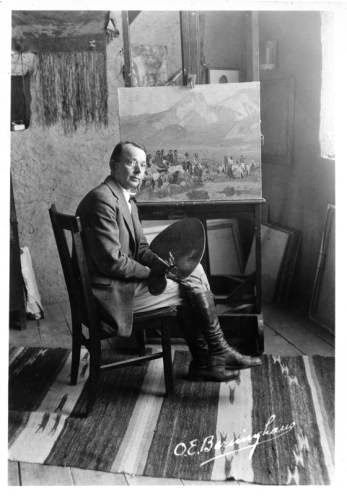
Oscar E. Berninghaus was a founding member of the Taos Society of Artists and one of the most accomplished American painters of the West and Southwest of his generation, a St. Louis-trained commercial lithographer turned easel painter whose discovery of Taos in 1899 set the course of the rest of his career and helped to establish the city as one of the great American art colonies.
Oscar Edmund Berninghaus (October 2, 1874 – April 27, 1952) was an American painter and a founding member of the Taos Society of Artists. Born in St. Louis, Missouri, the son of a lithographer, he left school at sixteen to join Compton & Sons, a local lithography firm, where he learned the technical disciplines of engraving, color separation, and printmaking, and attended the Saint Louis School of Fine Arts at night. In 1899 the Denver and Rio Grande Railway sent him west to depict the scenery along its route, and on that trip he made the visit to Taos that would shape the rest of his life.
For the next quarter-century he divided his year between his commercial-art practice in St. Louis and a Taos studio he occupied in the summers; in 1925 he made the move permanent. He was one of the six founding members of the Taos Society of Artists in 1915, alongside Joseph Henry Sharp, E. Irving Couse, W. Herbert Dunton, Bert Geer Phillips, and Ernest L. Blumenschein, and his work helped to establish the visual identity of the Society's first generation. Among his most prominent commissions were murals (the Capitol Lunettes) for the Missouri State Capitol in Jefferson City and a long sequence of historical paintings for the Anheuser-Busch Brewing Company, including the 1914 promotional volume Epoch Marking Events of American History. His work is held in the Smithsonian American Art Museum, the Saint Louis Art Museum, the Eiteljorg Museum, the Harwood Museum of Art, and other major American collections.